
Cutting EPS foam board may look simple, but achieving clean, accurate edges requires the right tools and techniques. Whether you use EPS for insulation, packaging, construction, or DIY projects, proper cutting can reduce material waste and prevent damage. With a few practical methods, you can achieve professional-looking results efficiently and consistently.
From choosing the appropriate cutting tool to measuring, marking, and finishing each piece, every step affects the final result. In this guide, we will show you how to cut EPS foam board like a pro, covering practical cutting methods, safety considerations, and useful tips for producing precise shapes and smooth edges.
What are EPS Foam Boards?
EPS foam boards are rigid insulation panels made from expanded polystyrene, a lightweight plastic material containing many small foam beads. Manufacturers expand polystyrene beads with steam and mold them into boards of different thicknesses and densities.
Because EPS combines low weight, thermal insulation, moisture resistance, and easy processing, it is widely used in construction and packaging.
Benefits of EPS Foam Boards
EPS foam boards provide several practical advantages for construction, insulation, packaging, and industrial applications:
- Excellent Thermal Insulation: EPS foam boards contain many air-filled cells that slow heat transfer, helping maintain stable indoor temperatures and reducing heating and cooling requirements in walls, roofs, floors, and other building areas.
- Lightweight Construction Material: EPS boards are much lighter than many traditional insulation materials, making them easier to transport, handle, cut, and install while potentially reducing labor requirements and transportation costs on construction projects.
- Moisture Resistance: EPS has a closed-cell structure that provides useful resistance to moisture absorption. When correctly specified and installed, EPS boards can maintain their insulating properties in environments with occasional moisture exposure.
- Easy to Cut and Shape: EPS foam boards can be cut into different sizes and shapes using knives, saws, hot wire cutters, or specialized equipment, making them suitable for customized construction, packaging, modeling, and insulation projects.
- Cost-Effective Insulation: EPS offers a practical combination of thermal insulation performance and affordability. Its low weight can also reduce transportation and handling expenses, making it an economical option for large-scale insulation projects.
- Good Structural Support: Depending on density and specification, EPS boards can provide useful compressive strength for applications requiring moderate load resistance, including floor insulation, foundation systems, and other demanding construction applications.
How to Cut EPS Foam Board?
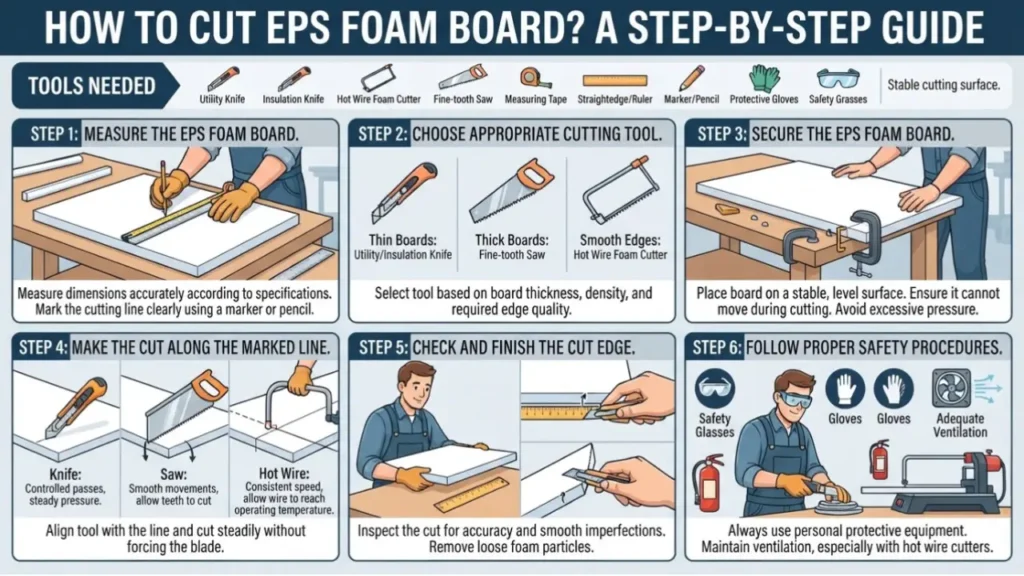
Cutting EPS foam board requires the right tools, accurate measurements, and controlled movements. The cutting method you choose depends on the board thickness, required shape, and application.
For construction and industrial projects, proper preparation helps produce clean edges, maintain dimensional accuracy, and minimize material waste. Follow these steps for consistent cutting results.
Tools Needed
- Utility knife or insulation knife
- Hot wire foam cutter
- Fine-tooth saw
- Measuring tape
- Straightedge or ruler
- Marker or pencil
- Protective gloves
- Safety glasses
- Stable cutting surface
Step 1: Measure the EPS Foam Board
Begin by measuring the required dimensions of the EPS foam board according to your project specifications. Use a measuring tape or ruler to check the length and width carefully. Accurate measurements help ensure the finished board fits correctly and reduce unnecessary material waste during the cutting process.
Mark the cutting line clearly with a suitable marker or pencil. For long, straight cuts, position a straightedge along the marked points to create a reliable cutting guide. Double-check all measurements before cutting, especially when multiple boards must have identical dimensions for insulation or construction applications.
Step 2: Choose the Appropriate Cutting Tool
Select a cutting tool based on the EPS board thickness, density, and required edge quality. A sharp utility or insulation knife can handle thinner boards, while a fine-tooth saw is suitable for thicker materials. Hot wire cutters are particularly useful when smooth, accurate edges are required.
Consider the production requirements before selecting your cutting method. For repeated industrial cutting, specialized EPS cutting equipment can improve speed, consistency, and dimensional accuracy. Using an unsuitable tool may crush the foam, create uneven edges, or increase material waste during the cutting operation.
Step 3: Secure the EPS Foam Board
Place the EPS foam board on a stable, level cutting surface before starting. Make sure the board cannot move during cutting, as unwanted movement can cause inaccurate dimensions or uneven edges. For larger boards, additional support may be necessary to keep the material stable throughout the process.
Position the marked cutting line where it is easy to follow from your working position. Avoid placing excessive pressure on the foam while securing it because EPS can compress under force. Proper positioning allows the cutting tool to move smoothly and consistently along the intended line.
Step 4: Make the Cut Along the Marked Line
Align the cutting tool carefully with the marked line before beginning. When using a knife, apply steady pressure and make controlled passes instead of forcing the blade through the foam. For a saw, use smooth movements and allow the teeth to cut without excessive pressure.
When using a hot wire cutter, allow the wire to reach its operating temperature before cutting. Move the wire steadily through the EPS at a consistent speed. Avoid stopping unnecessarily, as inconsistent movement can create irregular edges or affect the final dimensions of the board.
Step 5: Check and Finish the Cut Edge
After completing the cut, carefully inspect the board for uneven sections, damaged areas, or dimensional differences. Compare the finished piece with your original measurements to confirm that the length, width, and shape meet the required specifications. Accurate inspection helps identify problems before the board is installed or processed further.
If minor imperfections are present, carefully trim them using an appropriate cutting tool. Avoid removing excessive material, particularly when the EPS board must meet precise construction or insulation dimensions. Clean away loose foam particles from the finished edge and prepare the board for its intended application.
Step 6: Follow Proper Safety Procedures
Always use appropriate personal protective equipment when cutting EPS foam board. Safety glasses can help protect your eyes from foam particles, while suitable gloves can provide additional protection when handling sharp cutting tools. Keep the work area organized and remove unnecessary objects before beginning the cutting process.
If you use hot wire equipment, follow the manufacturer’s operating instructions and maintain adequate ventilation. Heated EPS can produce fumes, so avoid working in poorly ventilated areas. Keep the cutting equipment away from combustible materials, and allow heated components to cool completely after finishing the cutting operation.
EPS Foam Applications
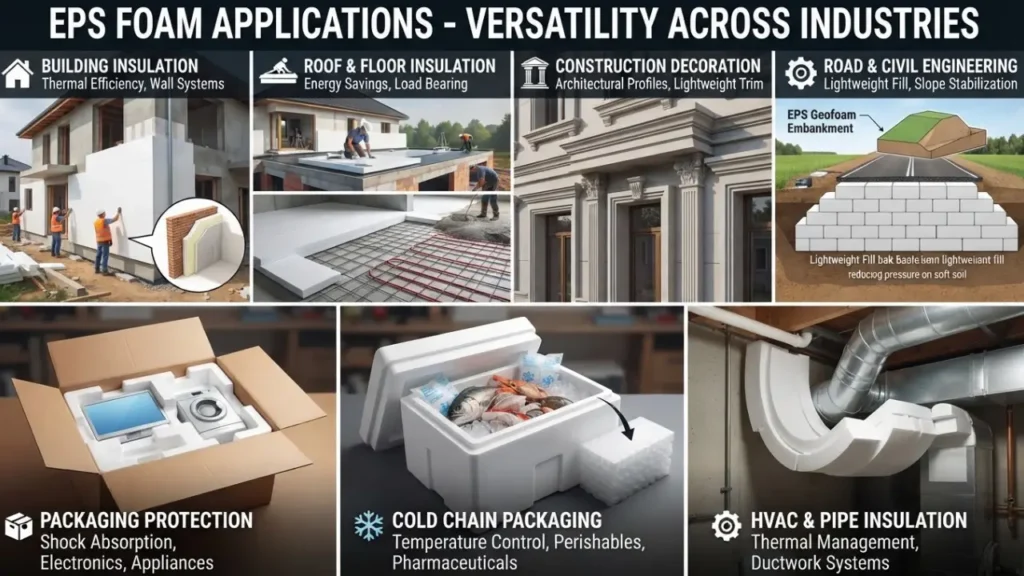
EPS foam is a lightweight and versatile material used across construction, packaging, transportation, and industrial sectors. Its combination of thermal insulation, cushioning, low weight, moisture resistance, and easy processing makes it suitable for many applications.
Depending on density, thickness, and design, EPS foam can be manufactured to meet different performance and project requirements.
HVAC and Pipe Insulation: EPS foam can be formed into components for insulating certain pipes, ducts, and HVAC systems. Its thermal insulation properties help reduce unwanted heat transfer, while its lightweight and machinable structure allows manufacturers to produce customized shapes that fit specific equipment and installation requirements.
Building Insulation: EPS foam is widely used for wall, roof, floor, and foundation insulation. Its low thermal conductivity helps reduce heat transfer and improve building energy efficiency. Different densities and thicknesses can be selected according to insulation requirements, climate conditions, structural needs, and local construction standards.
Packaging Protection: EPS foam provides effective cushioning for fragile products during transportation and storage. Its lightweight structure absorbs impacts and helps protect electronics, appliances, glass products, equipment, and other sensitive goods from shocks, vibration, and accidental handling damage throughout the distribution process.
Cold Chain Packaging: EPS foam is commonly used for temperature-sensitive packaging because its cellular structure provides thermal insulation. It can help slow temperature changes during transportation, making it suitable for certain food, pharmaceutical, seafood, and other temperature-sensitive products when combined with appropriate cooling materials and packaging systems.
Construction Decoration: EPS foam can be shaped into decorative architectural elements, including moldings, cornices, columns, trims, and other design features. Its lightweight structure makes installation and handling easier, while its machinability allows manufacturers to create detailed profiles and customized decorative components for different building styles.
Road and Civil Engineering: High-density EPS can be used as a lightweight fill material in selected civil engineering projects. It can reduce loads placed on underlying soil and structures, making it useful for applications such as road embankments, slope stabilization, and ground improvement where lightweight construction materials are required.
Roof Insulation: EPS foam boards can be incorporated into roofing insulation systems to help reduce heat transfer through the roof structure. Their lightweight characteristics simplify transportation and installation, while different board thicknesses and densities allow contractors to select products according to specific thermal and structural requirements.
Floor Insulation: EPS foam is used beneath floors and concrete slabs to provide thermal insulation and, when properly specified, support required compressive loads. It can help reduce heat loss through floors while contributing to more comfortable indoor environments and improved overall building energy performance.
Why Choose Our EPS Foam?
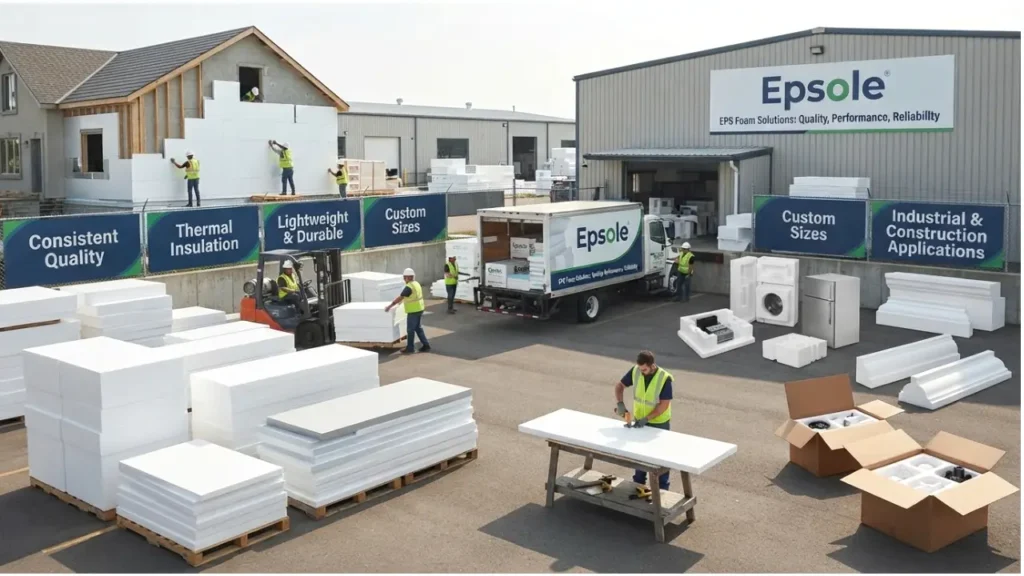
Choosing the right EPS foam supplier can directly affect product quality, insulation performance, project efficiency, and overall costs. At Epsole, we provide EPS foam solutions designed for different construction, packaging, insulation, and industrial requirements.
Our focus is on consistent quality, practical performance, flexible specifications, and dependable service to support customers across different markets.
- Professional Customer Support: We work with customers to understand their application requirements and recommend suitable EPS foam specifications. From product selection and dimensions to packaging and order arrangements, our team aims to provide practical assistance and responsive communication throughout the purchasing process.
- Consistent Product Quality: We manufacture EPS foam with controlled material selection and production processes to maintain consistent density, dimensions, and physical properties. This consistency helps customers achieve reliable performance across different projects and reduces variations when using EPS foam boards or blocks for repeated applications.
- Multiple Density Options: We can provide EPS foam in different density specifications to suit various applications and performance requirements. Whether you need lightweight material for packaging or higher-density foam for construction applications, selecting the appropriate density helps balance insulation, strength, weight, and cost.
- Custom Sizes and Thicknesses: Different projects require different foam dimensions, so we offer flexible size and thickness options. Customized EPS foam can help reduce unnecessary cutting and material waste while making installation, processing, packaging, and transportation more efficient for customers with specific product requirements.
- Excellent Thermal Insulation: Our EPS foam provides reliable thermal insulation for suitable building and industrial applications. Its cellular structure helps reduce heat transfer, making it useful for walls, roofs, floors, foundations, cold-chain packaging, and other applications where maintaining temperature control and improving energy efficiency are important.
- Lightweight and Easy to Handle: EPS foam combines useful performance with a lightweight structure, making transportation, handling, cutting, and installation more convenient. Its low weight can also help reduce logistics and labor requirements, particularly when customers need to handle large quantities of foam products.
- Reliable Wholesale Supply: We support wholesale customers with EPS foam products for larger commercial and industrial requirements. Our EPS production capabilities help provide consistent product supply, while flexible specifications allow businesses to source materials according to their application needs, order quantities, and project schedules.
Conclusion
Learning how to cut EPS foam board correctly can make your projects easier, cleaner, and more efficient. Choosing the right tool, making accurate measurements, and using controlled cutting techniques can help minimize waste and prevent rough or damaged edges. With proper preparation, even beginners can achieve consistent results across different EPS foam applications.
For thin EPS boards, a sharp utility knife can provide simple and accurate cuts, while hot wire cutters are ideal for smooth edges and customized shapes. Thicker boards may require a fine-tooth saw or specialized equipment. Regardless of the method, always maintain a stable workspace, use appropriate safety equipment, and ensure proper ventilation.
If you are looking for reliable EPS materials for construction, insulation, packaging, or other applications, choosing a dependable supplier is equally important. Epsole provides wholesale EPS foam products for different project requirements. Contact Epsole to explore suitable EPS foam solutions and get competitive wholesale options for your business.